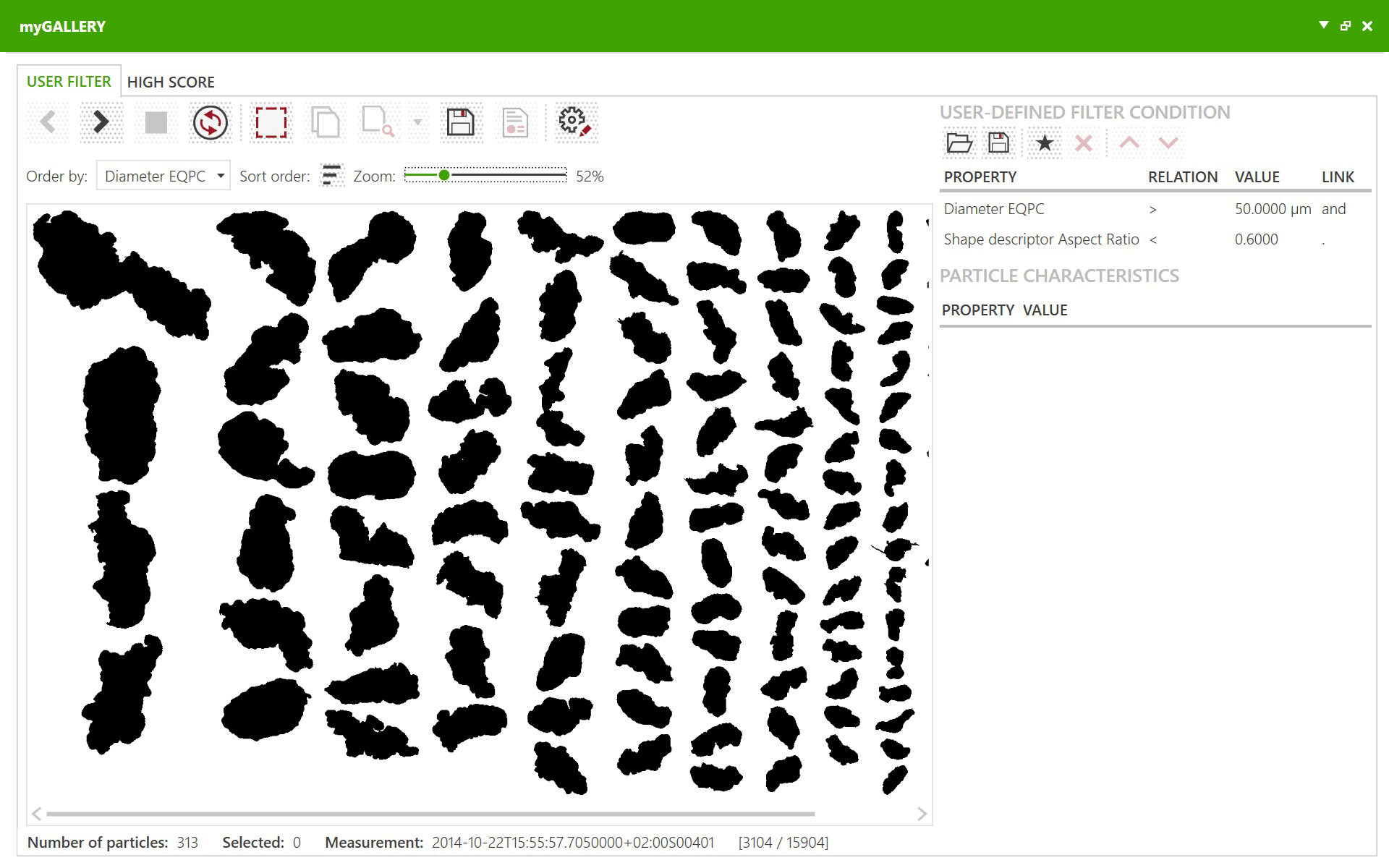





High-sensitivity particle imaging marks a revolutionary advancement in environmental monitoring, industrial quality control, and public health safety. Conventional approaches typically use chemical isolation, spectral analysis, or large-volume sampling that lack the resolution to detect particles at the submicron or even nanoscale level. In contrast, this method utilizes cutting-edge optics, AI-driven analysis, and cryogenically cooled sensors to visualize and quantify contaminants that were previously invisible to conventional analysis.
The foundation of this innovation is real-time particle capture through focused laser beams and nanoscale-resolution cameras. Particles suspended in air or liquid are drawn through a focused laser beam, causing them to scatter light in unique patterns based on their size, shape, composition, and refractive index. The unique light patterns are captured at rates exceeding 10,000 fps, allowing for the continuous monitoring of particulate matter without the need for chemical labeling or lengthy preparation steps.
Its exceptional sensitivity sets it apart from all prior methods. Current platforms identify particulates measuring as little as 10 nanometers in diameter, far below the threshold of traditional optical microscopes. This capability is critical when monitoring for airborne allergens, industrial nanoparticles, microplastics in water supplies, or biological agents such as viral particles and bacterial spores. In controlled environments such as semiconductor fabs or GMP-certified pharma labs, even a single rogue particle can compromise an entire batch of sensitive components. Operators gain the ability to locate contamination triggers accurately and respond in real time.
AI-powered analysis dramatically increases the functional value of these platforms. Machine learning models are trained on vast libraries of particle signatures to classify contaminants automatically. It isn’t merely labeled as debris—it can be classified as alumina, nylon microfiber, or a section of SARS-CoV-2 capsid.
Applications span across industries. In municipal and industrial water plants, it detects microplastic fibers and heavy metal nanoparticles missed by standard filters. Hospitals use it to screen for bioaerosols in surgical suites and quarantine zones. Ecologists apply it to monitor atmospheric releases from factories or eruptions with unmatched spatial resolution. Brands across cosmetics, infant care, 粒子形状測定 and food sectors employ it to certify products are devoid of toxic particulate residues.
Its implementation is hindered by several technical and logistical constraints. Consistent accuracy demands frequent calibration using NIST-traceable particulate standards across diverse settings. The continuous stream of high-frame-rate imagery produces staggering amounts of data. Edge processors with embedded neural networks reduce bandwidth needs and enable instant decision-making. Additionally, the cost of high-end imaging systems remains a barrier for smaller laboratories, though ongoing technological advances are steadily driving prices down.
Growing public and regulatory focus on ultrafine contamination is fueling demand for precise, high-fidelity detection systems. What began as an experimental tool has evolved into a critical pillar of contamination monitoring infrastructure. This power to visualize the previously undetectable is transforming contamination response from reactive to predictive. Offering a proactive rather than reactive approach to safeguarding human health and environmental integrity. With continued innovation, this technology promises to make trace-level detection as routine and reliable as measuring temperature or humidity.